Practice TM3 Exams Free - Latest TM3 Test Preparation
Wiki Article
BTW, DOWNLOAD part of BraindumpsPrep TM3 dumps from Cloud Storage: https://drive.google.com/open?id=18M7ODSVcWqfD7ijd5TTqxW8tT2KWa1hB
If you want to make your IT dream come true, you just need to choose the professional training materials. BraindumpsPrep is a professional website to provide IT certification training materials. Our TM3 exam training materials is the result of BraindumpsPrep's experienced IT experts with constant exploration, practice and research for many years. After you purchase our TM3 Dumps PDF training materials, we will provide one year free renewal service.
How can we occupy a place in a market where talent is saturated? The answer is a certificate. All kinds of the test certificationS, prove you through all kinds of qualification certificate, it is not hard to find, more and more people are willing to invest time and effort on the TM3 exam guide, because get the test TM3 Certification is not an easy thing, so, a lot of people are looking for an efficient learning method. And here, fortunately, you have found the TM3 exam copyright, a learning platform that can bring you unexpected experiences.
Latest TM3 Test Preparation - Reliable TM3 Study Guide
A variety of BraindumpsPrep’ TM3 dumps are very helpful for the preparation to get assistance in this regard. It is designed exactly according to the exams curriculum. The use of TM3 test preparation exam questions helps them to practice thoroughly. Rely on material of the Free TM3 copyright online sample tests, and resource material available on our website .These free web sources are significant for TM3 certification syllabus. Our website provides the sufficient material regarding exam preparation.
BCS TM3 Exam Syllabus Topics:
| Topic | Details |
|---|---|
| Topic 1 |
|
| Topic 2 |
|
| Topic 3 |
|
BCS ISTQB Certified Tester Advanced Level - Test Management v3.0 Sample Questions (Q50-Q55):
NEW QUESTION # 50
You are a process improver and have decided to use the data from the defect management system to identify and drive improvement actions... Which of the following options could have been identified as missing from the defect reports to be used for process improvement?
- A. The status of the defect
- B. The priority to fix the problem
- C. The software lifecycle phase in which the defect was detected
- D. Steps to reproduce the failure, along with the actual and expected results
Answer: C
Explanation:
Comprehensive and Detailed Explanation From Exact Extract of ISTQB Certified Tester Advanced Level - Test Manager v3.0 syllabus:
Forprocess improvement and root-cause analysis, the syllabus highlights the value ofdefect origin and detection phase datato evaluatewhere defects are injected and where they are detected, calculate removal effectiveness, and focus improvements (e.g., earlier-phase prevention or reviews). Thelifecycle phase detectedenables meaningful analysis ofphase containment, trends, and improvement targets; the other fields are useful operationally but less pivotal fororganizational/process improvement analytics(Chapter 2: Test Management in the Organization - improvement approaches using defect data; Chapter 5: Reporting and analysis of defect trends).
NEW QUESTION # 51
Assume that you are using traceability to manage test case coverage against test conditions. During test analysis, three test conditions were identified. Test design for system testing has been completed and 10 test cases (TC1 to TC10) have been designed, as described by the following traceability matrix ("C" indicates a critical test case, while "NC" indicates a non-critical test case):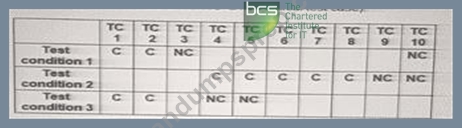
[traceability matrix not visible in the prompt]
The exit criterion for system testing states that each test condition must have all the associated critical test cases successfully executed (passed) AND all associated non-critical test cases at least executed.
The following is the situation after three days of system testing:
TC1, TC2, TC4, TC5, TC7, TC9: passed
TC3, TC10: failed (with an associated open defect report)
TC6, TC8: not run
Management wants to decide whether to release the system. You advise them that the system does not yet meet the defined exit criteria.
Based only on the given information, which test condition does not yet meet the stated exit criterion?
- A. Test condition 3
- B. Test condition 1
- C. Test condition 2
- D. None, all meet the stated exit criteria
Answer: C
Explanation:
The syllabus explicitly states thatexit criteriamust be met before considering completion of a test level:
"Exit criteria are the conditions that must be achieved to declare completion of a given test level... including coverage criteria and status of required tests (e.g., passed)."
- ISTQB CTAL-TM v3.0 Syllabus, Chapter 5Test Monitoring and Test Control And test control must act when exit criteria are not met:
"If the exit criteria are not satisfied, appropriate actions must be taken to address the situation."
- ISTQB CTAL-TM v3.0 Syllabus, Chapter 5
Sincetest condition 2 still has critical tests not yet executed, thedefined exit criteria are not fulfilled, and therefore a release decision should not be approved.
NEW QUESTION # 52
Management is sceptical regarding the budget request (€25,000) for the next testing project. You are asked for a cost-benefit calculation. Based on historical data from several projects, you have the following numbers:
Average prevention cost per defect: €200
Average cost of detection per defect: €400
Average cost of internal failure: €150
Average cost of external failure: €2,500
Expected number of defects to be found in this project during testing: 50 What is the result for the expected cost-benefit calculation for the upcoming project?
- A. €62,500
- B. €92,500
- C. €72,500
- D. €87,500
Answer: D
Explanation:
Comprehensive and Detailed Explanation From Exact Extract of ISTQB Certified Tester Advanced Level - Test Manager v3.0 syllabus:
Using thecost of qualityperspective in the syllabus, compute the savings from moving defects fromexternal failuretointernal discovery(prevention + appraisal + internal failure).
Internal discovery cost per defect:€200 + €400 + €150 = €750.
External failure cost per defect:€2,500.
Net saving per defect moved inside:€2,500 # €750 = €1,750.
For50defects:€1,750 × 50 = €87,500#answer: €87,500.The syllabus directs test managers to articulate testing' s value by quantifyingavoided external failure costsagainstprevention, detection, and internal failure costs, supporting investment decisions and demonstrating ROI for testing initiatives (Chapter: Test Management in the Organization - economics/cost of quality; business case and benefit evaluation).
NEW QUESTION # 53
Which of the following tools help to understand which part of the test object has been exercised by testing?
- A. Test execution tool
- B. Static analysis tool
- C. Requirements management tool
- D. Code coverage tool
Answer: D
Explanation:
Comprehensive and Detailed Explanation From Exact Extract of ISTQB Certified Tester Advanced Level - Test Manager v3.0 syllabus:
UnderTest Tool and Automation, the syllabus explains thatcoverage tools(often calledcode coverage tools) measurewhich parts of the code or structure(e.g., statements, branches, conditions) have beenexecuted by tests. This directly answers the question about "which part of the test object has been exercised." Amanages requirements and traceability, not execution coverage.
Bexecutes tests but typically does not measure structural coverage of the code by itself.
Canalyzes code without executing it; it identifies defects or coding standard violations, not runtime coverage.
Relevant syllabus areas:Test Tool and Automation-Coverage measurement tools(structural coverage for assessing extent of code exercised by testing).
NEW QUESTION # 54
You are a test manager in charge of integration, system, and acceptance testing for a bank. You are working on a project to upgrade an existing ATM to allow customers to obtain cash advances from supported credit cards. The system should allow cash advances from €20 to €500 (both inclusive) for all supported credit cards. The supported credit cards are American Express, copyright, Eurocard, and Mastercard. The system should be easy to use for all users, including new users.
In the master test plan, the following items are listed in the section named "items and/or features to be tested":
I. All supported credit cards
II. Language localisation
III. Valid and invalid advances
IV. Usability
Assume that the project has now been completed, and the ATM system has been in use for just over two months. You are planning a retrospective meeting for the testing work performed.
Which of the following areas is most likely to be considered in this retrospective?
- A. The requirements engineering process
- B. Operational defects occurred during the first two months of production
- C. Comparing actual tests completed versus estimated number of tests
- D. Documenting the final and open defect list
Answer: B
Explanation:
Comprehensive and Detailed Explanation From Exact Extract of ISTQB Certified Tester Advanced Level - Test Manager v3.0 syllabus:
In theTesting Process(Test Completion and improvement), the syllabus directs the test manager to useproduction and operational feedback(includingdefects found in live operation) as key inputs tolessons learnedandtest process improvement. A retrospective held after two months in production wouldspecifically examine operational defect datato evaluate test effectiveness, coverage, and the adequacy of acceptance criteria and non-functional aspects (e.g., usability, localization).
OptionB(final/open defect list) is part oftest completiondeliverables at project close, not the primary new focus of apost-deployment retrospective.
OptionC(requirements engineering process) may be discussed, but themost directly relevant and new evidencefor improvement after release isoperational defects.
OptionD(planned vs. executed tests) is amonitoring/controlactivity during the project; it can inform improvement, butlive defect trendsare the principal post-release focus.Relevant syllabus areas:Testing Process-Test Completion(lessons learned; inputs from production and operations to improve future test planning and approach).
NEW QUESTION # 55
......
In the case of studying with outdated ISTQB Certified Tester Advanced Level - Test Management v3.0 (TM3) practice questions, you will fail and lose your resources. BraindumpsPrep made an TM3 Questions for the students so that they don't get confused to prepare for TM3 Certification Exam successfully in a short time. BraindumpsPrep has designed the real TM3 exam dumps after consulting many professionals and receiving positive feedback.
Latest TM3 Test Preparation: https://www.briandumpsprep.com/TM3-prep-exam-copyright.html
- Reliable TM3 Test Price ???? Free Sample TM3 Questions ✔️ New TM3 Study Guide ✔️ Download ▛ TM3 ▟ for free by simply searching on ⏩ www.troytecdumps.com ⏪ ????TM3 Training Solutions
- TM3 Exam Sample ???? TM3 Latest Study Guide ???? Reliable TM3 Test Price ???? Go to website ⇛ www.pdfvce.com ⇚ open and search for ▷ TM3 ◁ to download for free ????Test TM3 Dates
- TM3 Valid Test Bootcamp ???? Best TM3 Study Material ???? Reliable TM3 Learning Materials ???? Download ⏩ TM3 ⏪ for free by simply searching on ➠ www.examcollectionpass.com ???? ????Best TM3 Study Material
- Test TM3 Questions ???? Reliable TM3 Learning Materials ???? New TM3 Study Guide ✋ Easily obtain ➠ TM3 ???? for free download through ⮆ www.pdfvce.com ⮄ ????TM3 Exam Materials
- New TM3 Study Guide ⚓ Reliable TM3 copyright Sheet ???? TM3 Test Simulator Fee ???? Search for 《 TM3 》 and easily obtain a free download on ▷ www.practicevce.com ◁ ????Reliable TM3 Test Price
- TM3 free practice torrent - TM3 real pdf test ???? Go to website ➤ www.pdfvce.com ⮘ open and search for [ TM3 ] to download for free ????Test TM3 Questions
- Reliable TM3 Learning Materials ???? TM3 Practice Online ???? Test TM3 Questions ???? Download ➠ TM3 ???? for free by simply searching on 《 www.testkingpass.com 》 ????TM3 Latest Study Guide
- Free Sample TM3 Questions ???? Best TM3 Study Material ???? Reliable TM3 copyright Sheet ???? Easily obtain 「 TM3 」 for free download through 「 www.pdfvce.com 」 ????TM3 Practice Online
- TM3 Exam Materials ???? TM3 Exam Sample ???? Cert TM3 Guide ???? Search for ✔ TM3 ️✔️ and download it for free immediately on ( www.verifieddumps.com ) ????Test TM3 Questions
- Reliable TM3 Test Price ???? Test TM3 Questions ???? Well TM3 Prep ???? Search on ▛ www.pdfvce.com ▟ for ➠ TM3 ???? to obtain exam materials for free download ????New TM3 Study Guide
- Reliable TM3 Exam Syllabus ???? Reliable TM3 Exam Syllabus ???? TM3 Exam Sample ???? Open ⇛ www.torrentvce.com ⇚ enter { TM3 } and obtain a free download ????TM3 Training Solutions
- ztndz.com, stevekwnr976184.lotrlegendswiki.com, nellkivl678595.blognody.com, samerawad.com, eduimmi.mmpgroup.co, yourbookmarklist.com, bookmarkingdelta.com, theoosmv898730.wikilinksnews.com, bookmarkassist.com, thebookmarkking.com, Disposable vapes
2026 Latest BraindumpsPrep TM3 copyright and TM3 copyright Free Share: https://drive.google.com/open?id=18M7ODSVcWqfD7ijd5TTqxW8tT2KWa1hB
Report this wiki page